Key Takeaways from the First National Parkinson’s Project Advisory Council Meeting
Jul 07, 2026 Nora Wong
On June 29, 2026, the National Parkinson’s Project (NPP), led by the National Institute of Neurological Disorders and Stroke (NINDS) within the National Institutes of Health (NIH), convened its inaugural meeting of the Advisory Council on Parkinson’s Research, Care and Services (ACPRCS).
Established under the Dr. Emmanual Bilirakis and Honorable Jennifer Wexton National Plan to End Parkinson’s Act, the ACPRCS, comprised of federal and non-governmental partners, is responsible for advising the U.S. Department of Health and Human Services (HHS) on the development of a national strategy to improve research, care and services for people affected by Parkinson’s disease and related disorders, including PSP, CBD and MSA. Jessica Shurer, MSW, LCSW, Director of Clinical and Community Affairs at CurePSP, serves as a member of the Advisory Council.
In advance of the meeting, Kristophe Diaz, Chief Executive Officer of CurePSP, submitted formal public comment outlining the organization's priorities for the National Plan. These included equitable representation of atypical parkinsonian disorders and expanded access to specialized care for the conditions CurePSP serves. Read CurePSP's public comment here for the full list of priorities.
Congressmen Gus Bilirakis (R-FL) and Paul Tonko (D-NY), sponsors of the legislation, provided opening remarks of gratitude for the expertise on the Council and support for urgent action. Representatives from several federal agencies delivered presentations on current programs and data on Parkinson’s disease and related disorders.
Key Takeaways
- Atypical parkinsonism disorders remained part of the conversation throughout the meeting. PSP, CBD and MSA experiences were represented through seats on the Council, in discussions ranging from diagnosis and care to research priorities and in the oral public comments delivered at the meeting. NIH also announced plans to begin publicly reporting research investments in separate categories for PSP, CBD, MSA and broader neurodegenerative parkinsonian disorders beginning in 2027. The added transparency could help the community see where research dollars are going, identify gaps and track progress toward future priorities.
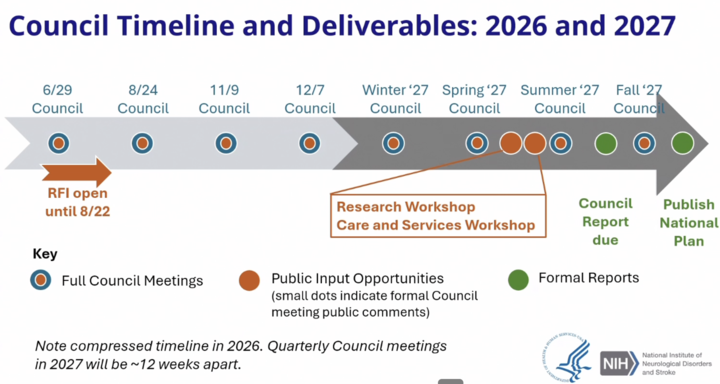
- Public engagement will be an ongoing part of the National Plan. NIH announced a new Request for Information (RFI), open through August 22, 2026, and outlined plans for future public workshops and public comment periods at upcoming Council meetings. Outside experts will also have opportunities to inform the Council's work through subcommittees and other engagement channels. Public input is intended to remain a central part of the National Plan process going forward.
- The Council plans to build on existing expertise rather than starting from scratch. Discussions referenced lessons learned from the National Alzheimer’s Project Act (NAPA), emphasizing transparency, measurable goals, stakeholder engagement and flexibility. The Council also pointed to existing federal programs, Centers of Excellence, multidisciplinary care models and expertise from outside organizations as resources to strengthen its recommendations.
Themes Discussed by the ACPRCS
- Building a National Plan that equally addresses research, care and services. Council members emphasized the importance of balancing scientific advances with the immediate needs of people living with Parkinson’s disease, PSP, CBD, MSA and related disorders.
- Targeting disease progression across all forms. Council members unified around the urgent need to better understand the disease biology of Parkinson’s, PSP, CBD and MSA, including the relationship between them. That understanding is seen as foundational to developing biomarkers, tracking symptoms more accurately and ultimately building therapies that can slow or halt progression across multiple conditions, rather than treating each in isolation.
- Scaling access to specialized care. Council members discussed how lessons learned from federal models, including NAPA, Department of Veterans Affairs Parkinson’s Disease Research Education and Clinical Centers and other areas of healthcare could be adapted to improve access to specialized care for the parkinsonian disorders.
- Building a roadmap and organizing the plan for impact on people living with the diseases. Members discussed operational processes including the formation of subcommittees and the hosting of public workshops. They repeatedly emphasized that people with lived experience, clinicians, researchers and advocacy organizations should have ongoing opportunities to help shape the National Plan as it develops.
Public Comment Highlights
The meeting concluded with oral public comments, selected by the NIH from more than 160 written submissions, including four speakers who represented people impacted by PSP, CBD or MSA. These powerful stories underscored a sense of isolation that's all too common in this community, a craving for more information and opportunities to take part in research and the ripple effects these diseases have across families and every part of someone's life. Speakers called on the Council to move with urgency and to stay mindful of the wider Parkinsonian community, including specific groups like atypical parkinsonism, veterans and young-onset Parkinson's.
Next Steps for the PSP, CBD and MSA Community
As development of the National Plan continues, CurePSP will be closely following several next steps:
- Future Public Council Meetings are set for 2026: August 24, November 9 and December 7.
- Progress along the Council’s roadmap and projected timeline (see figure below), with final recommendations anticipated in 2027 that will inform the first National Plan to End Parkinson’s and guide future federal priorities across research, care and services. Council timeline and deliverables in 2026 through 2027
CurePSP remains committed to ensuring that PSP, CBD and MSA are represented through the development and implementation of the National Plan. While these diseases are often discussed alongside Parkinson’s disease, they have unique clinical characteristics, care needs and research challenges that must be recognized within any national strategy.
Focused and coordinated efforts within the NPP to advance research, care and services for people with atypical parkinsonian disorders will only strengthen outcomes across the entire Parkinson's community.
CurePSP will continue to work alongside federal agencies, researchers, clinicians, advocacy organizations, community members and the broader Parkinson's community to ensure that the voices of people affected by PSP, CBD and MSA are heard throughout this process.
You can stay engaged by:
- Following CurePSP advocacy updates and action alerts
- Sharing your experiences as a person living with PSP, CBD or MSA or as a care partner with the NPP during public comment opportunities by emailing nationalPDplan@nih.gov
- Monitoring future NPP activities, such as Advisory Council meetings, workshops and public engagement opportunities
CurePSP will share updates through our website, newsletter and social media channels as the NPP moves forward.
.png)
.png)
.png)
.png)
Join our email list
Get the latest news and resources
directly to your inbox.
Get the latest news and resources directly to your inbox.
Sign Up