The goal of the Progressive Supranuclear Palsy (PSP) Trial Platform (PTP) is to determine whether new drugs are safe and have the potential to slow the progression of PSP.
Platform trials are a type of clinical trial that allows researchers to test multiple drugs at the same time, rather than having to run multiple trials for each drug. Because of this, platform trials often make research faster and more efficient.
The PTP Study will include a shared placebo group, which means participants will have a higher chance of receiving the active drug, rather than a placebo. Participants will be randomly assigned first to one of the study arms of the study and then randomized 3:1 to active drug or placebo.
To qualify, you must:
- Have had symptoms for five years or less.
- Be able to walk without a walker.
- Be able to understand the steps required for the trial and be able to give informed consent to the study.
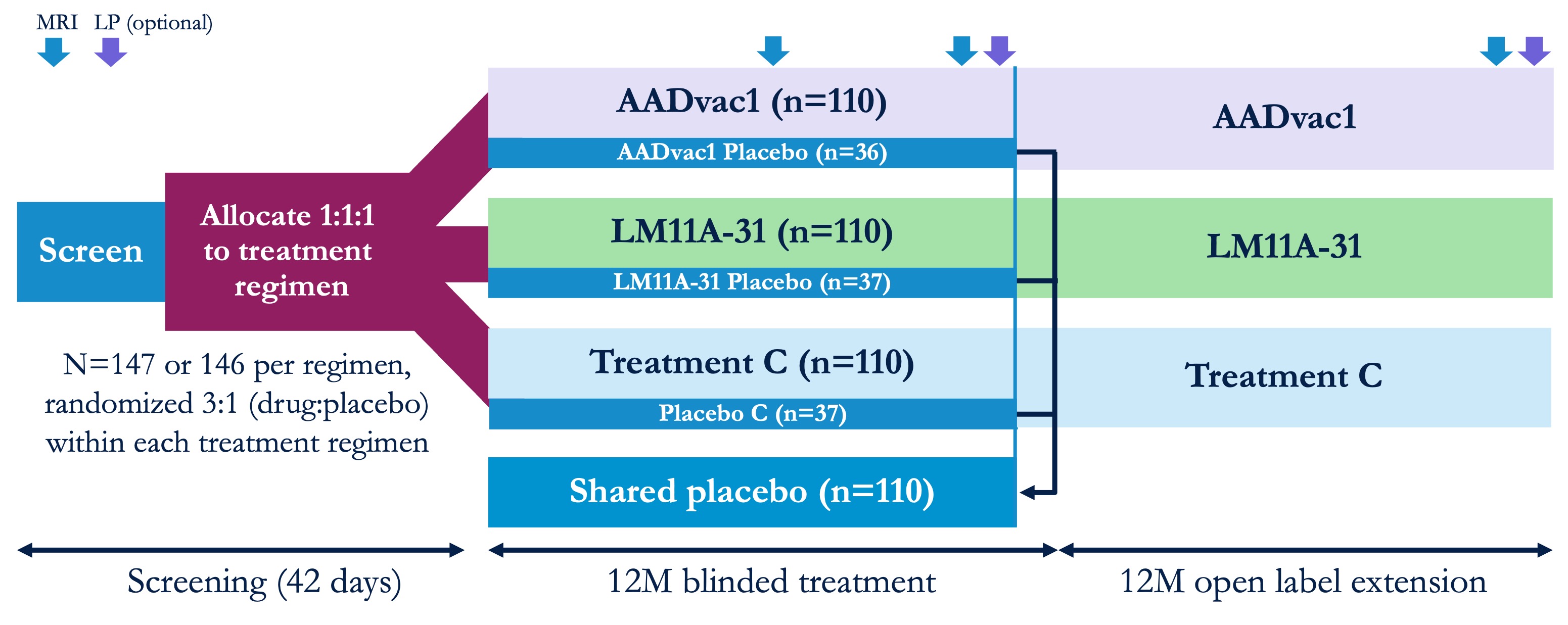
Approximately 50 sites across North America will participate in PTP. It will test three different study drugs, but additional drugs may be added in the future. For an updated list of which study drugs are included in the trial, visit our ClinicalTrials.gov listing (
NCT07173803
).
Each study drug will be tested for 12 months. You will have an option of continuing in the study for an additional year, during which time you would receive the active study drug.
Contact PI/Project Leaders: Adam Boxer (University of California, San Francisco), Irene Litvan (University of California, San Diego), Julio Rojas-Martinez (University of California, San Francisco), Anne-Marie Wills (Massachusetts General Hospital)

Funded by the National Institute on Aging/National Institutes of Health and run in collaboration with Alzheimer’s Clinical Trials Consortium, CurePSP, the Rainwater Charitable Foundation, and the Rossy Foundation.
For questions about the trial, eligibility or enrollment, please contact the PSP Trial Platform team at psptrialplatform@ucsf.edu or (415) 514-9420.
Find Out If You May Be Eligible!
To qualify you must: A detailed list of the trial's eligibility criteria can be found here (NCT07173803) but your nearest research site for PTP will formally screen you for the study. Your eligibility for PTP will ultimately be determined by a thorough assessment of your symptoms, a review of your medical history, and lab work that will be performed by one of our research sites. To determine whether you may be appropriate for PTP or other currently enrolling PSP trials, we invite you to complete the UCSF PSP Trials Prescreening Survey. This should take approximately 10-15 minutes to complete. Completion of this survey does not guarantee that you will be eligible for a trial, including PTP. You will still have to go through the screening process at your local site. To see a list of currently participating sites, see below a list of currently participating PTP sites. Contact Information for Participants: For more information about participating in the trial, call us at (415) 514-9420.
Frequently Asked Questions
If you are interested in participating in the PTP Study, you can complete the UCSF PSP Trials Prescreening Survey. This may help connect you with a trial site near you. A study coordinator from that site will reach out to you by phone or email to discuss your specific eligibility. If you prefer to contact the site yourself, we can provide you with the appropriate contact information. Contact information can be found on clinicaltrials.gov and on our locations listing on our site map.
You can also contact our central team by phone at 415-514-9420. There is no cost to participate in this study. Procedures related to the study will be provided at no charge and transportation to and from the study site will be reimbursed up to a certain amount, depending on distance travelled. There may be additional travel support available for study participants. For more information, please contact our team via email at psptrialplatform@ucsf.edu or by phone (415) 514-9420. Several study drugs (referred to as potential therapies) are being tested. The first study drugs have already been selected and more will be added over the next few years. No. Participants in the PTP Study are randomly assigned to one of the regimens, or specific treatments. Neither researchers nor the participants can choose which treatment they will receive and there is an equal chance of being assigned any of the regimens. Each study treatment has been carefully selected by researchers based on the best scientific evidence available. There is a 75% chance you will receive the active study drug and a 25% chance of receiving the placebo. Participants will be told which regimen they are assigned to and the name of the study drug. The research team at your local site will review your medical records. If you are not a patient at that site, your records will need to be faxed over. After the research team reviews your medical records, they may request additional information.
If the prescreen is successful, the research team will connect you with a clinical site or provide you with that site's contact information. The site may then invite you to begin the official screening process. This process includes 3 visits over 6 weeks. These visits help the study team make sure it is safe and appropriate for you to participate, and if you are eligible, to take part in the full trial. The treatment period is 12 months. After the treatment period, participants can choose to continue with the 12-month open-label extension (OLE) where they will definitively receive the active study drug. The trial involves 6 visits during the treatment period and 6 visits during the Open Label Extension (OLE). As new study drugs are added to the trial for testing, they may require additional procedures or visits that are specific to that regimen. During study visits, you can expect to participate in several tests and procedures. This might include a medical history and medication review, electrocardiograms (ECGs), physical and neurological exams, questionnaires, tests of thinking and memory, blood draws, and brain scans (such as an MRI). Lumbar punctures for spinal fluid are optional. The schedule will vary by visit and your local research site will give you the opportunity to ask questions about the exact schedule and procedures prior to making the decision to enroll.
Join our email list
Get the latest news and resources
directly to your inbox.
Get the latest news and resources directly to your inbox.
Sign Up