Seven Marathons, Seven Continents, Seven Days: Bryan Metoyer Runs Across the World For His Father
May 14, 2026 Oscar Sullivan
Bryan Metoyer had spent the past several hours wedged into an antiquated cargo plane with some 70 other athletes, makeshift toilets strapped to the hold. When the engines finally cut off, the only sound was wind. A horizon of ice and white in every direction. Forty-five minutes later, he would be at a starting line in Antarctica — the first of seven, on seven continents, in seven days.
His body couldn’t decide whether it was hot or cold. The course was a 2.6-mile loop run ten times. The terrain shifted beneath his feet without warning — loose snow that swallowed his steps like beach sand, then patches of glassy ice that demanded full concentration. The sun never set, hanging in the sky and glaring off the ice, strong enough to cause temporary blindness. The first half carried him on wonder alone. Then the wonder was gone, and something else had to take its place.
Bryan’s father taught him how to run. Growing up in Greenville, South Carolina, his dad coached his teams, ran races alongside him and showed up at every finish line from Los Angeles to New York. He raised five boys and didn't believe in shortcuts. Persistence and determination — Bryan heard those words so many times they stopped sounding like words and just became the way things were. He carried them into the Marines, and every race thereafter. He was carrying them now because his father no longer could. PSP had taken that from him.
Bryan had thought about the World Marathon Challenge for years. So when his father was diagnosed with PSP, he signed up. Training in South Carolina had been going fine until one July afternoon when he was working on his roof and fell. He shattered his heel in three places. Surgeons inserted a plate and six screws. He would not bear weight on it until September. Doctors told him to find something better to do. He didn’t. That left just over three months to get his foot in good enough shape to run around the world. He logged miles on the elliptical and waited. One week of real marathon training, then it was time.
In those final laps in Antarctica, Bryan was thinking about his father. That’s what replaced the wonder. He picked up the pace in the second half, pushing under nine-minute miles to cross the first finish line. He had just 45 minutes to eat, change and get back on the cargo plane. As he sat folded in his seat, his stomach churned. His body was wrecked and wired, too worked up to rest, too depleted to do anything else. Somewhere over the Southern Ocean, he had six more continents to go.
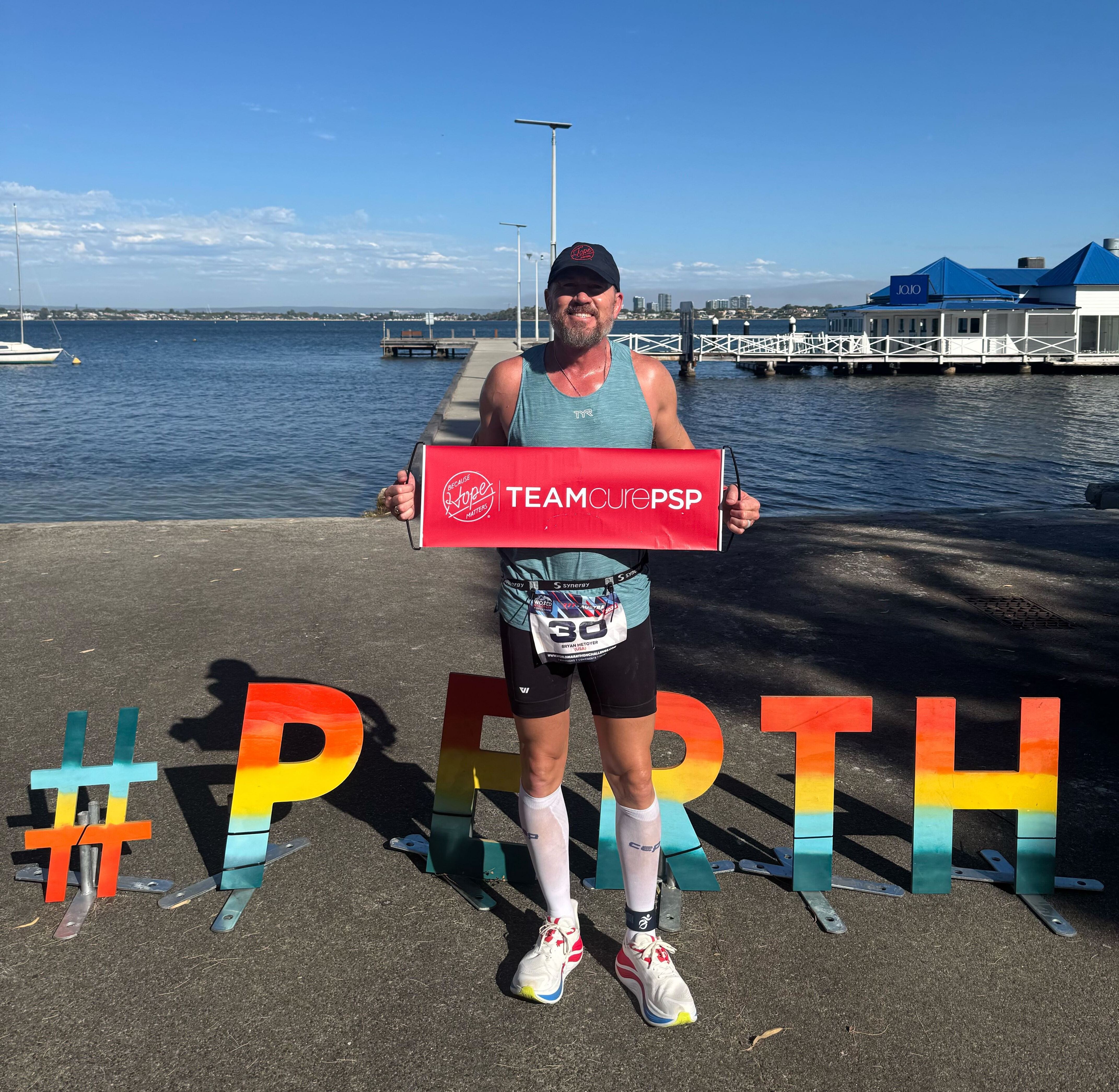
The next morning in Cape Town, his legs almost felt like legs again. The second race started at 6am on a flat beach with a cool breeze. He would be on a plane to Perth by four that afternoon, where the temperature on the tarmac was 109 degrees. Race directors warned them that they would be begging for Antarctica back. It was 98 degrees at race time with heat that never broke. The course was a 10K loop that just seemed to go on and on. Then his stomach began rumbling again. GI issues swept through the entire field — the worst they’d seen across any event they'd put on. The doctors on site had distributed roughly a dozen medications by race two. In previous years they'd given out maybe two total. Bryan still didn’t have an answer for it. "They still don't know if something was going around on the plane, or if it was the food, or just the constant moving and everything we were putting in our stomachs." Dehydration would become the new enemy.
Dubai was flat and hot and relentless. “Feels like I'm dying and being reborn each day.” In Dubai, he rose again. Then Madrid. The Circuito del Jarama, a cambered motorsport racetrack. The camber forced him to run sideways through every curve, and the hills nobody warned them about made it worse. By this point he was running on four hours of sleep across three days. His legs were paying for everything that had accumulated.
Through five continents, one thing had held. Then it rained in Brazil, and it didn’t stop. He crossed that finish line with blisters for the first time. Five days and 23 hours in, he stood at a starting line in Miami at 11pm. As Bryan ran into the final morning, the pain he'd managed across six continents finally caught up to him. Around mile 13, a sharp pain shot through his foot. He worried it was his Achilles tendon snapping. There was still half a race to finish. “I didn't care if I had to walk, crawl, whatever,” he said. “I was going to make it.”
The adrenaline pushed him through. So did everything his father had put in him. At the finish line, his mother, wife and oldest son were waiting. When he crossed it in the early morning darkness, he expected a wave of euphoria. It wasn’t that. Pain, struggle, confusion, isolation, relief, family. “Everything just came out.” Someone handed him an American flag as he embraced his wife.
Bryan ran alone across all seven continents, but he was never alone. Numerous CurePSP community members had been following his entire journey. One was a woman whose husband had been a long-distance runner — his last race had been the Peach Tree Road Race in Atlanta. A friend from high school reached out, someone Bryan had no idea was affected. Their father had been misdiagnosed with Parkinson's for years before dying from PSP. A few days after he finished, Bryan saw a comment on Instagram: “It's too late for my husband, he passed, but hopefully there's still hope for others and I appreciate what you're doing.”
Bryan hasn't seen his father since finishing. When he told him what he was doing, his father got emotional. That reunion is coming. PSP may not have a cure yet, but Bryan ran seven marathons on seven continents in seven days anyway — for his father and for everyone affected by these diseases. He’ll keep going until that changes.
Support Bryan's fundraising page dedicated to John here.
If you have a story to tell, share yours here.
.jpg)
.jpg)
.jpg)
.png)

.png)
.png)
.png)
Join our email list
Get the latest news and resources
directly to your inbox.
Get the latest news and resources directly to your inbox.
Sign Up